
Research
Modern photonic applications, such as organic light-emitting diodes (OLEDs) and photocatalysis, rely on high-efficiency luminophores that often contain heavy metals. Incorporating heavy metals such as iridium can enable ultrafast triplet excited-state dynamics, which drastically enhance OLED efficiency and promote photocatalytic activity. However, heavy-metal deposits are geographically concentrated in only a small handful of regions, leading to geopolitical issues and high prices. To enable sustainable, cost-effective photochemistry and support the rapidly growing OLED market with inexpensive emitters, it is crucial to find luminescent alternatives made from more abundant, widely accessible elements.
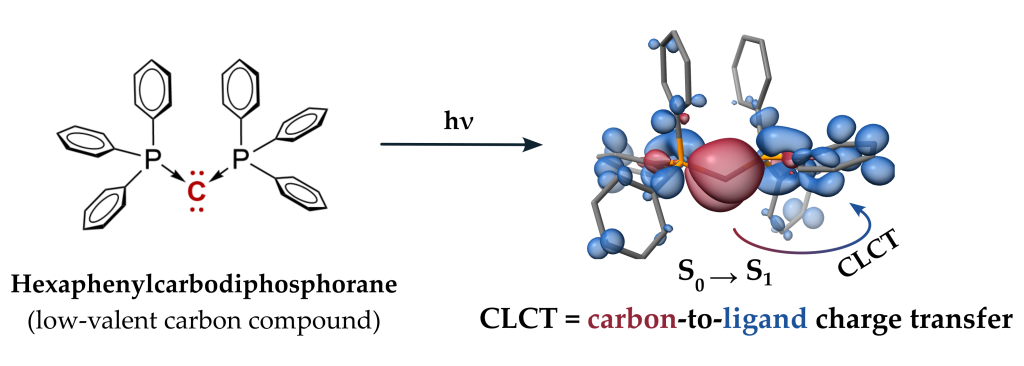
By combining advanced synthesis and sophisticated photophysical characterization with time-dependent density functional theory, our laboratory focuses on high-efficiency luminophores built solely from light elements. And our ultimate goal is to replace or complement heavy metals in modern photonic applications. To that end, we use common, widely accessible elements and chemically tune them into unusual electronic configurations that exhibit excited-state properties similar to those of heavy-metal complexes.